.jpg)
The London Laundromat: The Global Flow of Dirty Money
- Morgan McBride
- May 8
- 5 min read

The UK Foreign Affairs Committee previously determined that the city of London was like a "laundromat" for corrupt assets flowing in from Russia.

“The City of London was acting as a laundromat for fortunes acquired from misuse of power, political connections, or outright criminal activity.” - Edward Lucas (Center for European Policy Analysis)
Over the past decade, the allies of Russian president Vladimir Putin have worked to exploit existing gaps in the sanctions and anti-money-laundering regimes, allowing them to hide and launder their assets in London.
Before Russia’s full-scale invasion of Ukraine in 2022, Transparency International UK estimated that Russian individuals and companies, who had been accused of corruption or other suspicious links to the Kremlin, owned an estimated 1.5 billion pounds worth of property in the United Kingdom. Additional insights indicated that front companies registered in the UK and its Overseas Territories concealed over 82 billion pounds of corrupt Russian funds during this period.
The laundering of assets and wealth generates a lucrative business for British banks, law firms, wealth managers, and other intermediaries.
In recent years, the British government has been working to combat kleptocracy in the UK; however, an uphill battle remains in the reform and anti-money-laundering spaces.
“When dictators want somewhere to hide their money, they turn to Britain. When oligarchs want someone to launder their reputation, they come to Britain.” — Butler to the World by Oliver Bullough
However, even as the moniker “London Laundromat” became prominent, countries around the world have been prolific facilitators of kleptocratic behavior.
Kleptocracy is a system through which public institutions are utilized to enable a network of ruling elites and wealthy individuals to steal public funds for their own gain. Kleptocrats are empowered to gain from the system through their political connections and status, and by a lack of institutional oversight and accountability. The physical and digital fingerprints of a kleptocrat based in the United States can potentially be seen across all continents.
The inherently international aspect of kleptocracy is geared toward two primary objectives: laundering money and laundering reputations.
“Money laundering generally refers to financial transactions in which criminals, including terrorist organizations, attempt to disguise the proceeds, sources, or nature of their illicit activities.” — The U.S. Treasury Department
As a frequent component of other serious crimes like trafficking and smuggling, money laundering helps independent criminals and criminal organizations illegally move their funds around the world, as they attempt to integrate illegal funds into the legal economy.
In this article, we explore how Golden Visa schemes, reputation laundering, and money laundering amplify the system of illicit behavior that can traverse nations and economies.

Golden Visa Schemes
A golden visa (also known as a residency-by-investment program) authorizes foreign nationals to have the right to live, work, and study in another country for a substantial fee. The fee can often be applied through a real estate transaction, a business investment, or another monetary/capital contribution.
At face value, golden visa schemes can be perceived as lucrative ways to bolster a nation’s economy; yet the process has increasingly been weaponized by illicit actors who skirt official systems.
Over the last decade or two, a global market in second citizenship and investor visas has emerged, allowing foreign nationals to acquire the right to reside in OECD countries and other potentially attractive nations through perfectly legal means.
During a “blind faith period” spanning from 2008 to 2015, over 3,000 people obtained investor visas to the UK. Although some of these visas may be unproblematic, illicit actors on the global stage have managed to acquire them. For instance, Nirav Modi, an Indian billionaire awaiting extradition on charges of defrauding a state-owned bank of 1.5 billion pounds, secured a UK investor visa. Mukhtar Ablyazov, the son of a former energy minister in Kazakhstan, who was accused of embezzling five billion dollars from a state bank, also acquired a UK investor visa.
“[The UK] remains the soft underbelly of dodgy Russian money,” and the golden visa program has been a “gold-plated invite to launder money in the UK.” — Chris Bryant, a Labour Party Member of Parliament
This scheme is not unique to the United Kingdom, as U.S. President Donald Trump’s Gold Card allows foreign nationals to pay a $15,000 Department of Homeland Security processing fee, pay a $1 million contribution, and complete a background check to receive U.S. residency in record time.

A report from the Financial Action Task Force (FATF) and the Organization for Economic Co-operation and Development (OECD) indicated that Golden Visa schemes enable criminals to increase their global mobility and hide their identities and criminal activities across jurisdictions worldwide.
Reputation Laundering
Reputation laundering involves minimizing or obscuring evidence of corruption and authoritarianism in the kleptocrat’s home country and rebranding kleptocrats as engaged global citizens.
After securing residency in a new country and acquiring wealth, kleptocrats and their family members attempt to gain traction in a new civil society through managing their reputations via public relations agents, forging ties with political and business leaders, and stifling reporting of their alleged wrongdoing.
The acquisition of a new “clean” image allows these individuals to become prominent voices in Western democracies. Philanthropy to universities and charities in the UK has been one way for post-Soviet elites to clean up their reputations. For instance, the British international law firm Mishcon de Reya represented Maxim Bakiyev of Kyrgyzstan, during which the firm threatened the organization Global Witness with legal action for its intention to publish a report on a money-laundering scandal in Kyrgyzstan.
Although reputation laundering can have a harmless façade, the clean image of the kleptocrats gives them increased access to global mobility and improved opportunities to evade sanctions and authorities.
Dirty Money Flowing Around the World
Illicit economies allow for dirty money to exchange hands all around the world. The UN Office on Drugs and Crimes estimates that the amount of money laundered annually equates to 2-5% of the global GDP — which in 2026 equates to trillions of dollars.
Forming a gigantic loophole for traditional systems, these illicit economies undercut the regulations of other countries, skirt sanctions, widdle down tax rates, and launder the money of criminals and their organizations.
Although many instances of money laundering continues to occur worldwide, the similarly named Azerbaijani Laundromat scandal arose when a 2.9 billion dollar operation came to light. Between 2012 and 2014, this scandal led to approximately three million dollars leaving Azerbaijan’s economy on a daily basis.
According to reports by The Guardian, companies with ties to the president of Azerbaijan [Ilham Aliyev], state ministries, and the International Bank of Azerbaijan have been subsequently identified as the source of the laundered money. The next piece of the puzzle became the notion that said funds were transferred into four offshore-managed UK companies.
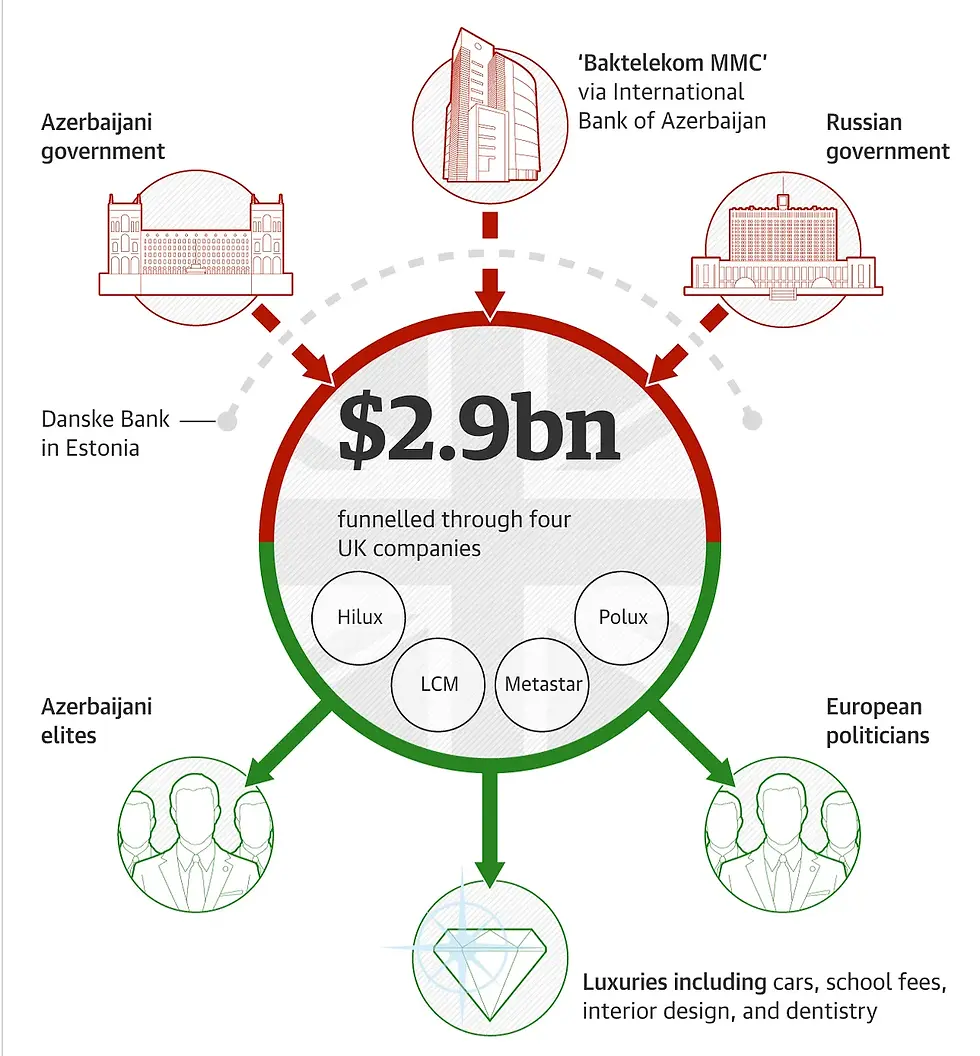
The laundered funds were then utilized by Azerbaijani elites and European politicians as they acquired luxury goods and experiences. Keeping the international aspect of money laundering alive, the funds from the Azerbaijani Laundromat were spent in a number of countries like Germany, France, Turkey, Iran, Kazakhstan, and the United Kingdom.
When Danske — the Danish bank that initially processed these funds — noticed the scheme in 2024, it reported the suspicious transactions to authorities, since the money flowed through their Estonian bank branch.
Beyond this scandal, other scandals in Denmark, Germany, and other nations have illustrated how dark money from kleptocracies and clean reputations of kleptocrats can flow easily through the many systems around the world.
-------------------
Sources:
https://www.opensocietyfoundations.org/voices/time-to-shut-down-dirty-money-s-london-laundromat
https://www.cnbc.com/2018/05/21/london-is-a-laundromat-for-russias-dirty-money-uk-report-warns.html
https://www.chathamhouse.org/2021/12/uks-kleptocracy-problem
https://link.springer.com/article/10.1007/s12117-020-09386-8
https://home.treasury.gov/policy-issues/terrorism-and-illicit-finance/money-laundering
https://www.interpol.int/en/Crimes/Financial-crime/Money-laundering
https://www.fatf-gafi.org/en/publications/Methodsandtrends/misuse-CBI-RBI-programmes.html
Butler to the World by Oliver Bullough


Comments