.jpg)
The Angola Prison Rodeo: The Exploitation of Louisiana's Incarcerated Population

The "Wildest Show in the South" uses incarcerated individuals as a Roman Colosseum style spectacle in Louisiana.
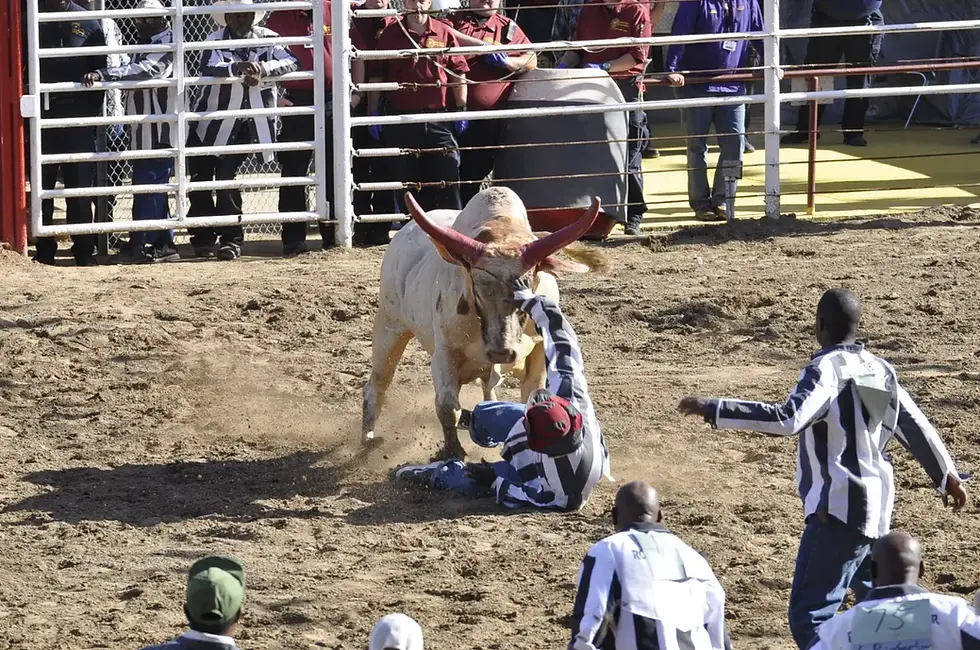
The Angola Prison Rodeo currently holds the title of the longest-running prison rodeo — yes, you heard that right. Getting its start in 1965, the penitentiary’s rodeo arena now accommodates over 10,000 attendees in Western Louisiana. With events hosted once in April and every Sunday in October, twenty dollars will get you in to see the unique spectacle at the Louisiana State Penitentiary at Angola.
The Prison Rodeo features traditional rodeo events such as bull riding, bronco riding, barrel racing, and steer wrestling. However, its paramount event remains Convict Poker, in which four prisoners play a hand of poker seated in the center of the arena while bulls are unleashed, and the last sitting prisoner wins. Another event — Prisoner Pinball — features prisoners standing throughout the arena in a randomly placed hula-hoop while a loose bull is unleashed on the arena. The last prisoner remaining in their hula-hoop wins the event.
The major event of the rodeo is Guts and Glory, which incorporates a poker chip fastened to the head of a massive longhorn bull and released into the arena, and the goal is for the inmates to snatch the bull’s chip to win the monetary prize.
The Angola Prison Rodeo acknowledges the event's dangers and states that professional rodeo handlers and protective gear are present for the prisoners.
The rodeo’s ticket sales have been attributed to funding the Inmate Welfare Fund, which funds recreational and educational programs for inmates. According to the Angola Prison Museum, inmate participation remains entirely voluntary and offers offenders a rare opportunity to feel part of society beyond the prison gates.

On paper, the voluntary rodeo events can give incarcerated individuals agency to participate in bull riding events, endurance challenges, and to sell their arts and crafts with community support.
Norris Henderson — the Executive Director of Voice of the Experienced [an organization aiming to restore the voting rights of formerly incarcerated people] — expresses that “This is kind of like the Roman Colosseum, where people come to cheer, not the humans in the arena; they come to cheer the animals.” As a former inmate at Angola prison for 27 years, Henderson’s words echo the sentiment that the untrained prisoners are putting their safety at risk for the chance to win a few hundred dollars in a place without any other similar opportunities.
Without mincing Henderson’s words or misconstruing his sentiments, it feels relevant to presume that the rodeo’s positioning as the only (or one of the very few) opportunities for incarcerated individuals to connect with a community or potentially earn money skews the beneficial nature of the event. For instance, if there were other non-life-threatening opportunities for incarcerated people to participate in community events and sell their crafts, would the perceived benefit of the rodeo for the inmates weaken?

When interviewed by Drew Hawkins from the New Orleans Public Radio, current Angola inmate Donald Cook suffered seven broken ribs and a collapsed left lung after a bull attacked him during a round of “Convict Poker”. Nevertheless, he does attest that the county fair nature of the event, beyond the rodeo event, shows him a continuing purpose that he craves while incarcerated.
Even though the inmates’ desire for continued community interaction and support remain understandable, the implicit dangers and exploitative nature of the Angola Prison Rodeo require further examination. Throughout the past sixty-one years of the event’s existence, broken bones, concussions, and snapped necks of incarcerated participants became standard.
The Angola prison rodeo highlights the need to provide incarcerated individuals with community connections (e.g., through the rodeo's community fair component); however, it doesn’t give the Louisiana State Penitentiary at Angola the legitimacy to exploit the incarcerated individuals in its care for monetary gain.

In January of 2017, the Louisiana Legislative Auditor revealed that the rodeo generated approximately 6.2 million dollars in revenue from 2014 and 2015 alone. Those funds were held in a private checking account with Highlands Bank in St. Francisville, Louisiana, and not with the Louisiana Department of Treasury, where the state could monitor them. According to reporting from Julia O’Donoghue in 2017, the state treasury had never held the revenue for the Angola prison rodeo events, meaning the money hadn’t been monitored by the Louisiana state government for a little over fifty years. The rodeo money is now directed to the Louisiana state treasury, yet the physical expenditure of rodeo funds remains murky. Rodeo funds have historically been described as flowing only to benefit the inmate population. However, the 2017 investigation into the rodeo’s finances and other subsequent investigations heightened suspicions that a misappropriation of funds had occurred with the Angola Prison Rodeo.

The Louisiana State Penitentiary (Angola Prison) is the largest maximum-security prison in the United States, as it additionally operates as a working farm on land historically tied to the Angola plantation. The prison’s plantation still produces cotton, sugar, corn, and other crops. With these fields being tended by incarcerated people at Angola prison, this arrangement eerily remains legal due to the exception in the 13th Amendment allowing slavery “as a punishment for crime.”
These agricultural programs pay the incarcerated individuals as little as two cents to forty cents per hour. Similarly, the prisoners who participated in the Angola rodeo events can earn between $200 and $2,000. While that is a substantial amount for an incarcerated individual in most circumstances, that is pennies compared to the profits earned by the prison as they exploit their own prisoners. The prison rodeo event makes an annual profit of around 1.7 million dollars, which vastly surpasses the amount of funds directly circulated the rodeo’s incarcerated participants.
Although recent investigations and policy discussions have arose regarding the future of the Angola Prison Rodeo, the lengthy history of Angola prison’s exploitation of its prisoners for public entertainment will continue to stain Louisiana and the U.S. criminal justice system — which will only deepen the longer the rodeo remains “a beloved pastime.”
As the Angola Prison Rodeo continues to orchestrate a Roman Colosseum style-spectacle, this arm of the “prison industrial complex” amplifies the myriad ways incarcerated individuals become a line-item in the extensive fiscal profile of the United States’ for-profit prisons.
----------------
Sources:
https://www.wwno.org/law/2025-05-06/brutality-and-humanity-at-the-angola-prison-rodeo
https://capitalbnews.org/angola-prison-rodeo-new-orleans-black-cowboys/
https://app.lla.state.la.us/PublicReports.nsf/0/55DE748EC2743692862580AD0075AD64/$FILE/000122DF.pdf
https://www.thenation.com/article/society/angola-prison-rodeo/
https://tulanehullabaloo.com/64613/news/angola-prison-rodeo-the-last-vestige-of-gladiators/
https://www.vianolavie.org/2022/09/30/angola-rodeo-the-wildest-show-in-the-south/


Comments