.jpg)
Sports, National Identity, & Politics

Triumph, athleticism, community support, and national identity. How do these aspects of culture collide in our understanding of ourselves and nations?

Beyond being an outlet for physical activity, sports have always been an entertaining pastime full of joy, excitement, and at times despair. Athletes around the world train and compete in arenas, on fields, on courts, and a variety of other unique venues. Their triumps and defeats highlight the immense passion and dedication needed for their endeavors to compete on the global stage. As a spectator of sports, fans at home and fans in the sporting arenas alike cheer on their team — or cheer merely for their love of the game. The thrill of sports has maintaned a dynamic presence on culture around the world for centuries. Still, the significance of sports permeates deeper into popular culture, national identities, and even into geopolitical circumstances.
Sports can be seen as central symbols in modern societies, especially in the guise of national identity, as they activate the stories of a nation's culture and legacy. National identity maintains a variety of meanings and understandings; however, it largely symbolizes the ways that individuals connect with the country they call home.
According to Benedict Anderson, national identity can be perceived as ‘imagined communities’ that utilize evergreen political formations and cultural representations in developing national symbols. A nation is not deemed “real” because there is no personal interaction among all its citizens, yet they still view themselves as part of the same group.
“A nation is not a metaphysical reality, born under the mark of an essence transmitted to all its citizens. Nor is a nation a genetic code instilled in each of its children. Nor is a nation a mere arbitrariness, a pile of farces, just a discourse of the powerful to control its population. The question remains: after all, what is a nation? It is a collective construction over several generations. A life shared around the same symbols, culture, institutions, language, habits. The nation is recognition.” — Jozsef Bozsik

An enhanced understanding of national identity can sometimes be considered nationalism, as it constitutes a more well-defined ideology. As an ideology, nationalism is a set of beliefs about a nation held by its people, largely involving a sense of pride or loyalty to one’s own nation. The duality of nationalism means that it can be both unifying and divisive for a nation’s people.
The inherent categorization of an “us vs. them” mentality polarizes the sociocultural understanding of who we are as individuals and communities at large. Unfortunately, we often see the weaponization of nationalism in the political landscape, as it can become a mechanism for political authority to infilitrate and cultivate a nation’s culture. For instance, extreme nationalism {ultranationalism} develops a degree of control over a nation’s population in the pursuit of specific interests for the political leadership. Many of these extremist pursuits become critical tools for fascist and authoritarian governments in the extreme sense.
Interesting research also explores the dynamics of sports nationalism and its permeance in other aspects of society. One study conducted by Ørnulf Seippel noted that, generally, countries with low GDPs and low levels of democracy and cultural globalization appear to be more sport-nationalistic than other countries. This suggests that nationalism’s relationship to sports also strongly ties a nation's political landscape and history.
Sport is perhaps the only avenue in which laborers {i.e. players/athletes} are recruited as citizens specifically for their short-term potential to enhance the nation’s international standing. International tournaments like the World Cup, the Olympics, and other global sporting events provide a platform for countries to present themselves to the world.
In many ways, sports offer a unique vantage point on collective identification for a nation, serving as powerful and visible symbols of national identity and nationalism.
Brazil’s Football Culture

Brazil’s nationalism and cultivation of national identities stem from a long history of myth-making that centers on the conflicting ambitions of the powerful and powerless within the nation.
In Brazil’s early days, beginning in 1822, after its independence from Portugal, the newly established central government struggled to assert control across the enormous landmass.
In the decades preceding Brazil’s 1964 military dictatorship and during its twenty-one-year reign, national identity centered around cultural markers that connect to the nation’s core ideologies. Government intervention in the formation of a “mass culture” facilitated the building of a national community across a vast geographic area, as seen in football’s connection to Brazilian culture.
Initially introduced in the United Kingdom, football grew into Brazil’s most popular sport and a prominent part of the nation’s mass culture. As a cultural marker, football highlighted the nation’s fascinating relationships and dynamics within its class-based and racialized national construction. Power and identity both play fundamental roles in the proliferation of football and nationalism throughout Brazil.
In the late nineteenth century, British immigrants who contributed to Brazil’s upper-class elite began creating football clubs that, in many ways, resembled aristocratic social clubs. So, football initially served as an elevated social status symbol, signifying an elite lifestyle.
Hoping to stray away from its idea of being a second-class country, Brazil aimed to amplify its whiteness in order to rid “themselves of the backward population”.

Brazil’s elite football structure gave way to a factory-based model in the early 1900s, allowing for greater inclusion of the working class in the sport. For instance, the Bangu Athletic Club was founded at a textile factory in the suburbs of Rio de Janeiro. Although its initial team had a more Eurocentric identity, its players taught the game to some factory workers, which helped expand local support for football.
Amateur football began to see an increased presence of black and mulatto players, especially in the interior regions of Brazil. Football clubs feared that including black players within their programs could threaten the present white hegemony and move black players away from their current working-class categorization. High-level politicians even instructed national team coaches to leave black players off the roster for international football matches due to their concern about Brazil’s overseas reputation getting damaged.
In 1923, the football club Vasco da Gama fielded a racially mixed championship team that altered the trajectory of the “color barrier” in Brazilian football.
However, President Getulio Vargas’ strong nation-building ambitions from the 1930s to the 1950s led to significant developments in football directly tied to his regime’s authoritarianism, populism, and broader nation-building. The regime united all the existing football clubs under the Conselho Nacional de Desportos to enhance football’s popularity and appeal throughout Brazil. With increasing government support, football began to permeate social discourse and become a staple of Brazilian life. During this time, radio broadcasts could connect and popularize football nationwide, which helped make players like Domingos and Leônidas national icons.
As the hosts of the 1950 World Cup, the nation had high hopes for a major title on home turf. Brazil managed to surpass numerous teams spectacularly, like a 7-to-1 win over Sweden. However, the final match between Brazil and Uruguay, before a crowd of 199,000, resulted in a shocking defeat for the home team. The public response to the loss sparked a discourse blaming the black defensive players for the team's loss. Remarks claimed that those players lacked the stamina and courage required for their role, which made them “scapegoats for the nation’s tragedy”. Similar to other cultural instances of race relations, the degradation of black and brown individuals of notoriety remains an alarming trend regarding the nation’s social construction of racial identities.
The futebol-mulato style of play, developed by Gilberto Freyre, used the ideology of racial democracy to counter the rational playing styles of European football teams. Brazilian football players were heralded for developing a beautiful version of the global sport featuring an artistic yet skillful use of the legs and the body. Brazil’s samba-style of play reflects a collaborative approach, with multiple cultural markers integrating into the nation’s identifiable traits. Using a relatively similar team to that of the prior defeats, this victorious 1958 team helped squash some of the racial stigmas and stereotypes that had been ameliorated earlier.
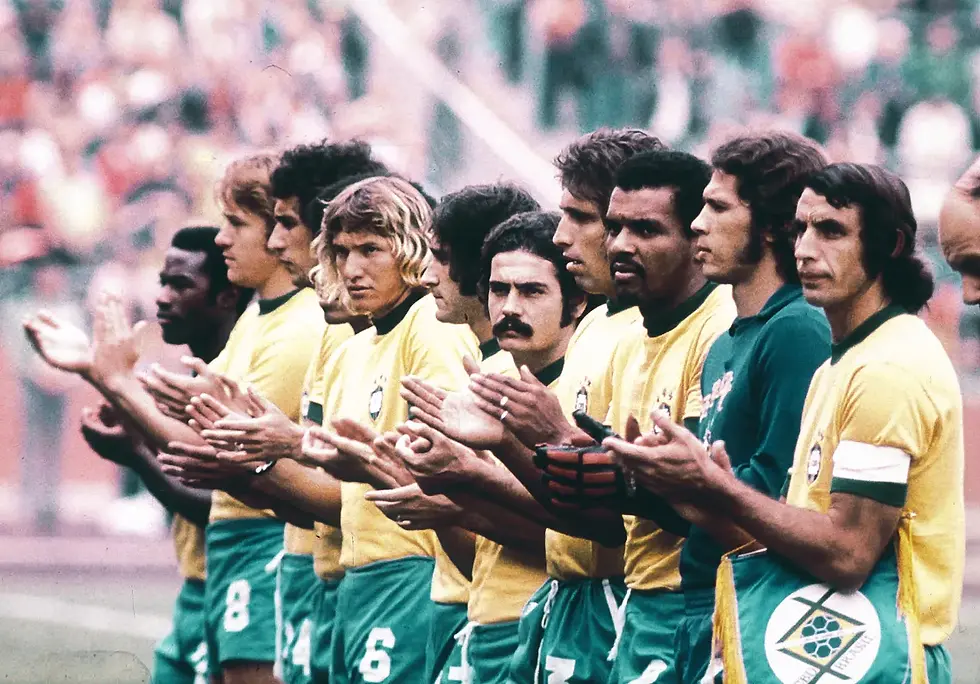
When reformist President João Goulart was overthrown via a military coup, a twenty-one-year-long military dictatorship began, ending Brazil’s first democratic period. The following repressive period, between 1968 and 1974, featured significant urbanization, internal migration from the Northeast to the Southeastern regions, mega-construction projects, and the use of network television as a national medium. The authoritarian leadership also invested in the Brazilian national team, the seleção, to capitalize on the nationalism derived from football success. National television broadcasting systems bolstered the government’s unification efforts by prominently depicting football matches on television sets across the nation. Brazilians were thus able to connect with the powerful symbolism of the flag, national anthem, and colors associated with the national football team. The military dictatorship skillfully amplified football's significant cultural presence through advances in television and broadcasting.
Towards the end of the twentieth century, Brazilian society increasingly viewed its football stars and the beautiful game as a ritual almost as valued as Carnaval. The stronghold of football success across the nation has become a significant focal point for Brazil to build its national identity around.
Michael Billig posits that national identity gains a permanent foothold because tokens of Brazil’s cultural makeup are consistently reemphasized. These signifiers are ever-present through the portrayal of pop stars, telenovela stars, and sporting heroes that individuals can admire. Successes by players like Garrincha and Pelé in World Cup victories in 1958, 1962, and 1970 helped amplify Gilberto Freyre’s ideas about the racial and cultural mixture as a means towards national success.

"To speak of “our football” is already to speak of “us” as a people. Brazilian football — with its methods, knowledge, characteristics — was only possible due to the guidance given by our culture. The beautiful Brazilian game belongs to the Brazilian people and their identity." -- Jozsef Bozsik
Yet with this in mind, the racism faced by the nation’s Black players persists throughout modern football culture. The Football Racial Discrimination Observatory (Observatório da Discriminação Racial no Futebo) in Brazil released data showing that there was a 72% increase in racism in Brazilian football in 2017 compared to the year before. In a match in 2014 between two professional Brazilian football clubs, Santos’ goalkeeper, Mário Lúcio Duarte Costa, a black man popularly known as Aranha (Spider) drew the referee’s attention to the stands. Grêmio fans were imitating monkeys and shouting racist phrases at him from the stands. Although these fans faced criminal charges and the team was eliminated from the competition, similar behaviors unfortunately continue to persist within Brazilian football culture.
Many assert that regardless of one’s level of success within the Brazilian soccer ecosystem, the historically elitist sport of soccer/football highlights the glaring blind spots of the role of national identity in Brazil.

With all of the components of national identity and nationalism in mind, the sport of football remains a strong example of an imagined community due to its consistent role in connecting Brazilians nationwide.
------------------
Sources:
https://www.ebsco.com/research-starters/political-science/nationalism
Andrade de Melo, V., & Drumond, M. (2014). Globo, the Brazilian Military Dictatorship and the 1970 FIFA Football World Cup: Ambiguous Relations. Television & New Media, 15(8), 703-710. https://doi.org/10.1177/1527476414535956
Brewin, J., & Williamson, M. (2014, April 30). World Cup History: 1950. ESPN.com. Retrieved May 9, 2023, from https://www.espn.com/soccer/news/story/_/id/1834555/1950
By SB , B. F. (2008, March 2). Charles Miller -- Scotland’s Gift to Brazil. Bleacher Report. Retrieved May 9, 2023, from https://bleacherreport.com/articles/11611-charles-miller-scotlands-gift-to-brazil
Daflon, R., & Ballvé, T. (2007, September 25). The Beautiful Game? Race and Class in Brazilian Soccer. NACLA. Retrieved May 9, 2023, from https://nacla.org/article/beautiful-game-race-and-class-brazilian-soccer
DaMatta, R. (2012). Sport in Society: An Essay on Brazilian Football. Vibrant Virtual Brazilian Anthropology, 6(2), 98–120. http://www.vibrant.org.br/issues/v6n2/roberto-damatta-sport-in-society/
De Vasconcellos Ribeiro, C. H., & Dimeo, P. (2009). The experience of migration for Brazilian football players. Sport in Society, 12(6), 725-736. https://doi.org/10.1080/17430430902944159
Eakin, M. C. (2017). Becoming Brazilians: Race and national identity in Twentieth-century Brazil. Cambridge University Press.
Jung, H. (2021). Building the Brazilian Nation through Futebol-Mulato: Racial Democracy, Visual-Aural Capitalism and the Rise of Cultural Citizenship in Twentieth-Century Brazil. Social Evolution & History, 20(1), 146–172. https://doi.org/10.30884/seh/2021.01.06
Lopes, J. S. L. (2000). Class, Ethnicity, and Color in the Making of Brazilian Football. Daedalus, 129(2), 239-270. https://www.jstor.org/stable/20027636
Porto, M. (2023). TV and national integration during the military dictatorship. Brazilian TV & Culture.
Prange, A. (2014, May 23). Both Victims and Heroes. Retrieved May 9, 2023, from https://www.dw.com/en/brazilian-football-plagued-by-racism/a-17646244
https://www.tandfonline.com/doi/full/10.1080/00207659.2017.1264835
https://www.tandfonline.com/doi/full/10.1080/17430430802019169
https://www.sportsvalue.com.br/en/racism-have-grown-in-brazilian-football/
https://www.espn.com/soccer/story/_/id/44207187/palmeiras-conmebol-punishment-racism-luighi-concacaf
https://www.tandfonline.com/doi/full/10.1080/17430437.2026.2668286#d1e111


Comments