.jpg)
Autocracy Inc.
- Morgan McBride
- Mar 1
- 7 min read

An exploration of Anne Applebaum's book "Autocracy Inc.: The Dictators Who Want to Run the World", and the way in which authoritarianism has been growing worldwide.

What are we talking about?
Democracy is broadly understood as ‘rule by the people’. In practice, it often equates to people/citizens choosing their leaders in free and fair elections. Democracy, thus, gives citizens the right to influence the important decisions that affect their lives, and also provides them with the autonomy to hold their leaders accountable.
In contrast, according to Merriam-Webster’s dictionary, autocracy is a form of government in which one person holds unlimited power.
Similarly, Merriam-Webster’s dictionary defines authoritarianism as a form of governance based on authoritarian principles, in which power is concentrated in a leader that is not constituionally responsible to its people.
Autocracy and authoritarianism are both non-democratic political systems plagued with highly concentrated power structures, yet they differ in scope. Autocracy refers to rule by one person or a small group of elites with absolute authority, while authoritarianism describes a broader style of rule that limits political pluralism and civil liberties in order for the leader to maintain power.
For instance, Saudi Arabia and China represent autocratic nations focused on the individual or small group of elites who hold the power of the nation. While, Turkey and Belarus present as examples of authoritarian nations in which the nature of power restricts the civil liberties of the nation’s people, while maintaining a facade of democracy.
Autocrats implement arbitrary rules on their citizens while simulatenously ignoring all constraints on themselves. Autocratic leaders typically maintain absolute control over their nation, while limiting political participation, and enforcing loyalty through fear, unpredictability, and dependency.
On the other hand, competitive authoritarian regimes do not directly utilize coercion; however, such regimes create a framework of legality for its own use and a sense of urgency to justify their own actions.
How did we get here?
In the latter portion of the 18th century, no country could be meaningfully considered a democracy. The Regimes of the World dataset created by Our World in Data classifies almost all countries in that period as closed autocracies, in which citizens didn’t have the right to choose their political leaders through elections.
Throughought the 19th century, many nations became electoral autocracies, in which elections determined the country’s political leaders; however, citizens often lacked additional freedoms to make such elections free and fair.
Electoral and liberal democracies spread throughout the 20th century, meaning that citizens had the right to choose the chief executive (i.e., president or prime minister) and the legislature in elections [electoral democracy], or that citizens also enjoyed individual and minority rights that made citizens equal before the law [liberal democracy].
By the start of the 21st century, democracy had become the most common political system around the world. The world was at its democratic “all-time high” in the early 2010s. However, since 2012, the number of countries that are autocratizing has been higher than those that are democratizing.
Many current democracies are less than a generation old. So, dictatorship is far from a distant memory. According to a chart generated by Our World in Data, most electoral democracies are younger than the nation’s senior citizens.
The replacement of global democratic norms with authoritarian practices will mean state controlled censorship, corruption, injustice, active manipulation of messaging, and impunity for state abuses.
Autocracy Inc. by Anne Applebaum
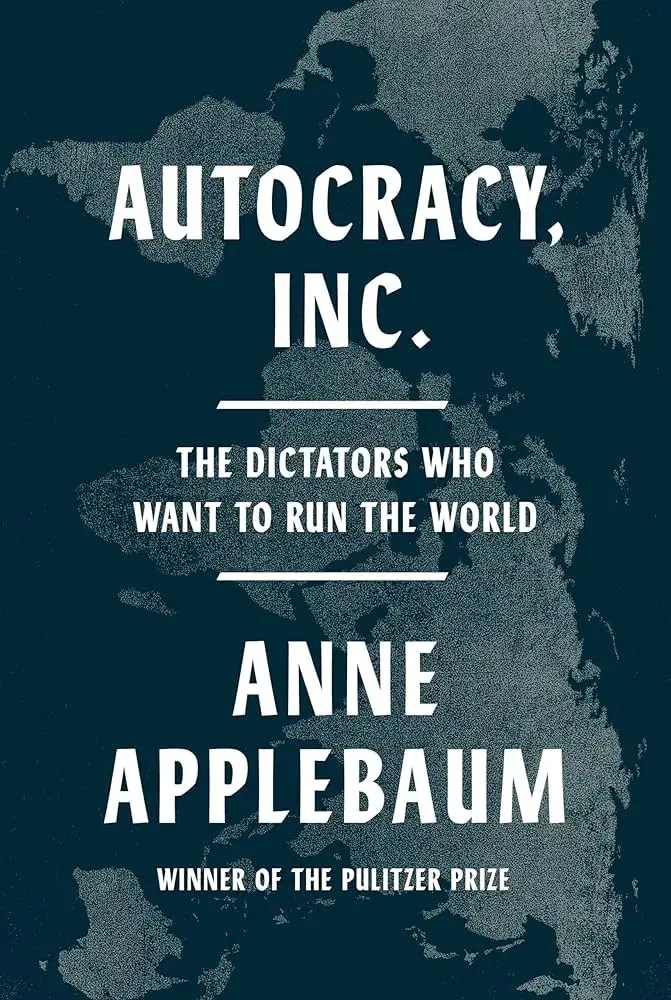
Pulitzer Prize-winning and New York Times bestselling author Anne Applebaum published Autocracy Inc.: The Dictators Who Want to Run the World in July of 2024.
The book detailed an alarming picture of how autocratic governments and leaders collaborate to undermine the democratic world, and how democracies and civil societies should organize to defeat them.
According to Anne Applebaum, autocracies are now underpinned not by just one dictator, but by sophisticated networks consisting of kleptocratic financial structures, surveillance technologies, and professional propagandists, all of which operate across multiple regimes, from China to Russia to Iran.
She further states that the members of Autocracy Inc. [autocratic leaders and their governments] are not linked by a unifying ideology, like communism, but rather by a common desire for power, wealth, and impunity.
Applebaum describes that our current geopolitical landscape is a very loosely knit mix of regimes, ranging from theocracies to monarchies, that operate more like companies eager to preserve their own wealth, repress their people, and maintain power at all costs.
Applebaum acknowledges that, “This is the core of the problem: the leaders of Autocracy, Inc., know that the language of transparency, accountability, justice, and democracy will always appeal to some of their own citizens. To stay in power, they must undermine those ideas, wherever they are found.”
The Maduro Model of Governance
One of the concepts emphasized in Autocracy Inc. refers to the theory developed by international democracy activist Srdja Popovic entitled “The Maduro Model of Governance”, after the former leader of Venezuela Nicolás Maduro. This model illustrates the willingness of autocrats to see their country become a ‘failed state’ — especially in accepting economic collapse, endemic violence, mass poverty, and international isolation — if the end result amounts to them staying in power or gaining additional power.
Essentially, leaders who adopt this model have a main goal of staying in power, so they are willing to destabilize neighboring countries, destroy the lives of ordinary people, or even send hundreds of thousands of their own citizens to their deaths.
Anne Applebaum demonstrates how this model currently manifests in countries around the world, including Syria, Venezuela, Belarus, and many others.

Freedom House, a nonpartisan organization that promotes democracy and global human rights, indicates Belarus as a consolidated authoritarian regime. Belarus earns a Global Freedom score of 7 out of 100 from Freedom House, where 0 is not free, and 100 is full freedom.
As a nation of over nine million people, Belarus sits in Eastern Europe on the western border of Russia.
Aleksandr Lukashenko has been Belarus’s first and only president since the position was established in 1994, amounting to a tenure of nearly 32 years.
According to Freedom House, political pluralism and political participation remain seriously limited in Belarus, as involvement in political activism can result in loss of employment, smear campaigns in the media, expulsion from educational institutions, fines, harassment, criminal charges, and imprisonment.
The Belarusian police and military used severe, and sometimes fatal, violence and arrested and detained over 35,000 people to crack down on the August to November 2020 pro-democracy protests, in order to ensure that Aleksandr Lukashenko would remain in power.
Sergei Sparysh, a 39-year-old activist who was released in 2025 after five and a half years of imprisonment, asserted that, “Lukashenko is an addict: his drug is power. Like any addict, he’ll do and sell anything for one last dose. To stay in power, he sold Belarus to Russia.”
In late 2021 and early 2022, Belarus gave Russian forces a significant strategic advantage in their full-scale invasion of Ukraine by allowing them to stage their assault on Kyiv from Belarus, which lies just fifty miles to the north of Ukraine’s capital.
Belarus has also become a base and training ground for the Wagner Group, a Russian paramilitary organization, and reportedly a host to Russian tactical nuclear weapons.
Furthermore, Belarusian factories also ramped up production, supplying Russia with clothes and essential goods during their war against Ukraine. However, since the yields did not last and Russia’s economy slowed under the pressure of sanctions and war spending, Belarus was ultimately dragged down with Russia.
Lukashenko’s collaboration with Putin’s Russia has isolated the landlocked nation of Belarus, which has produced a bout of economic uncertainty for Belarus. As Belarus’s leader until at least 2030, Lukashenko’s deepening relationship with Russia has placed them in opposition to their NATO allies and most of their neighboring European nations. Ultimately meaning that Belarus has to more heavily rely on the support and resources from fellow authoritarian and autocratic nations like Russia and China.
Aleksandr Lukashenko’s willingness to allow Belarus to decline as a state has led to disastrous impacts for the Belarusian people, yet his continuous hold on power in the nation continues to perservere, at least for now.
The Unionization of Autocracy
As democratic states struggle to maintain their solidarity with each other and decisively defend their interests and values, autocrats around the world have increasingly cooperated with one another to advance shared goals. Through security agreements, energy deals, joint investments, and other strategies, today’s autocrats cooperate with like-minded leaders to quash opposition, cement their rule, and create a global system hospitable to their allies and collaborators.

Anne Applebaum made a poignant point that, “Autocrats have an enormous incentive to spread that hopelessness and cyncism, not only in their own countries, but around the world.”
In Autocracy Inc., Applebaum further mentioned that many autocratic and authoritarian regimes operate on a “rule by law” principle, in which the “law” is whatever the current autocrat or ruling party leader declares it to be.
Some intergovernmental organizations, like the Shanghai Cooperation Organization (SCO), provide support networks and quasi-legal sheens over the actions of autocrats domestically and internationally. The ten member states of the SCO — China, India, Kazakhstan, Kyrgyzstan, Russia, Pakistan, Tajikistan, Uzbekistan, Iran, and Belarus — agree to recognize each other’s “sovereignty”, not to critize one another’s autocratic behaviors, and to not interfere in a member’s domestic policies.
The collaboration of autocrats and authoritarians on such a scale amplifies their ability to repress their own people, and erode democratic principles at home and abroad. Transnational repression has become a component of most autocratic governments, which ultimately helps destabilize global politics at large.
So What?
“A world in which autocracies work together to stay in power, work together to promote their system, and work together to damage democracies is not some distant dystopia. That world is the one we are living in right now.” - Anne Applebaum
Authoritarian aggression directly threatens the freedom, security, and prosperity of the world. Thus, the spread of anti-democratic practices around the world is not merely a setback for fundamental freedoms. It poses grave economic and security risks.
When more countries are free, all countries are safer and more prosperous. When more countries are autocratic and repressive, treaties and alliances crumble, nations and entire regions become unstable, and violent extremists have greater room to operate.
Anne Applebaum expressed that, “Everyone assumed that in a more open, interconnected world, democracy and liberal ideas would spread to the autocratic states. Nobody imagined that autocracy and illiberalism would spread to the democratic world instead.” However, she further states that, “No nation is condemned forever to autocracy, just as no nation is guaranteed democracy.”
--------------------
Sources:
Autocracy, Inc.: The Dictators Who Want to Rule the World by Anne Applebaum (2024)
https://freedomhouse.org/report/nations-transit/2024/region-reordered-autocracy-and-democracy
https://freedomhouse.org/report/freedom-world/2018/democracy-crisis
https://www.journalofdemocracy.org/articles/how-authoritarians-win-when-they-lose/
https://www.theguardian.com/world/2025/sep/30/his-drug-is-power-lukashenko-reaches-out-to-the-west
https://www.cfr.org/backgrounders/belarus-russia-alliance-axis-autocracy-eastern-europe
https://www.journalofdemocracy.org/articles/illiberal-democracy-and-the-struggle-on-the-right/
https://www.theatlantic.com/magazine/archive/2021/12/the-autocrats-are-winning/620526/


Comments